Our prices are final and include insurance. The photos show the actual cars you will drive. We also offer delivery to an address convenient for you. DL Rent wishes you a pleasant and safe journey.
Sometimes a rental car for €15–20 per day looks like an incredible deal. Especially when you book online and see a huge “lowest price” label.
But many people only discover the real cost of the rental once they start the booking process or reach the final payment steps.
That’s when additional conditions, insurance packages, deposits and the well-known “or similar vehicle” start appearing.
In the rent-a-car business, the advertised price is often just the beginning.
As someone who works with customers every day and sees real situations firsthand, I decided to write this article not as advertising, but as an honest look at some of the most common practices in the car rental industry.
“From €15 per day” — but how much will you actually pay?
This is probably one of the most common misunderstandings when booking a rental car.
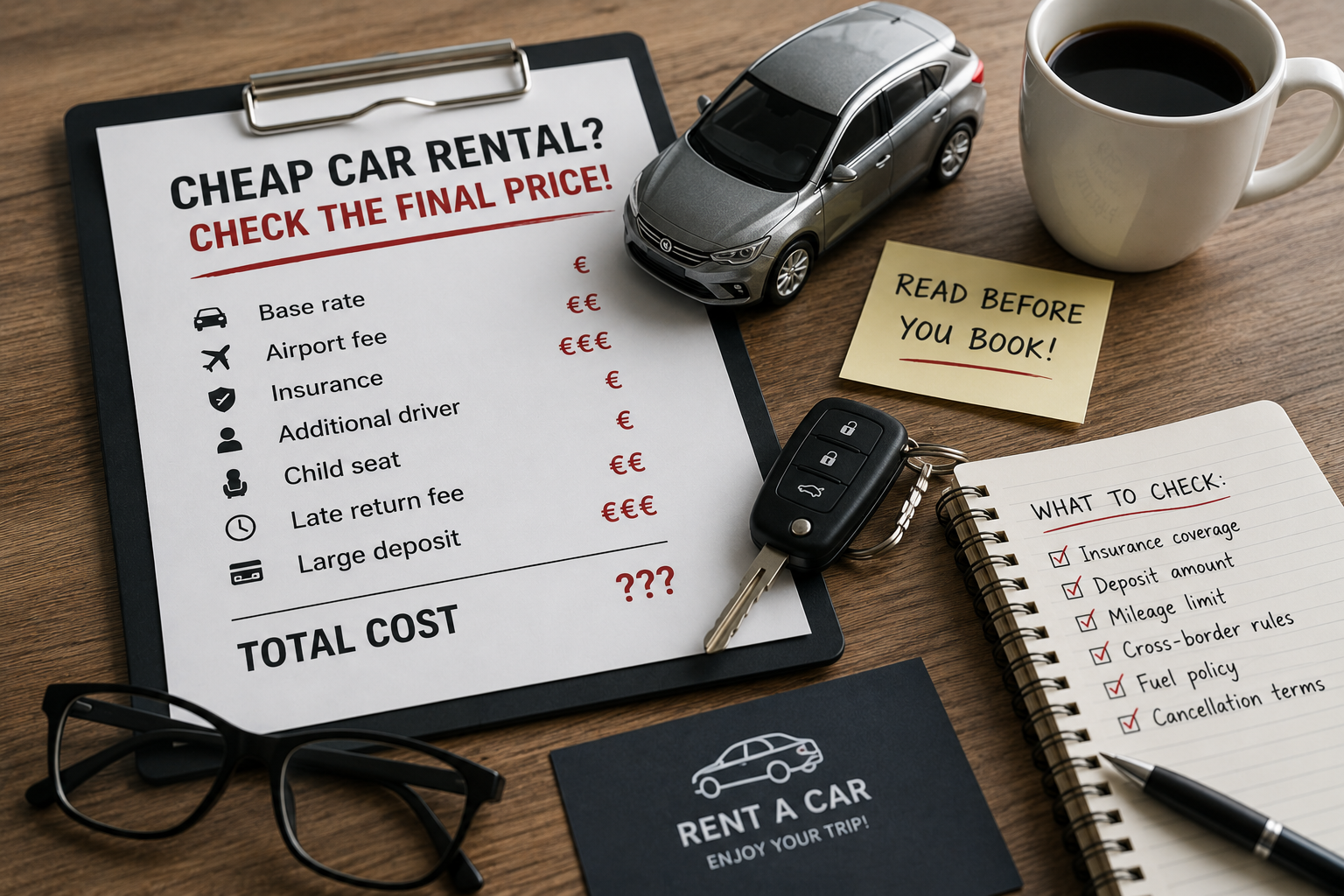
People see a low starting price and assume that’s the final amount. But during the booking process, additional costs often appear — insurance packages, deposits, mileage limits, additional driver fees, child seats or after-hours service charges.
It is important to clarify something:
not every additional charge is a “hidden fee”.
Some services naturally require additional resources — for example child seats, extra drivers, vehicle delivery or late-night service outside working hours.
The real issue starts when the advertised base price looks artificially low, while the actual rental cost only becomes clear during the final booking steps.
That’s when customers often feel they were attracted with one price but ended up paying something completely different.
What does “or similar” actually mean?
Many people overlook these two words.
But in reality, they allow you to reserve one vehicle and receive a completely different one at pickup.
For example:
you book an SUV with automatic transmission, but upon arrival you are offered a smaller vehicle, a different engine or simply another model that “belongs to the same category”.
Technically, the rental company may still be following its terms and conditions.
But for the customer, this can be disappointing — especially when traveling with family, luggage or specific vehicle requirements.
That is why more and more customers are looking for companies that work with real vehicles and transparent conditions from the very beginning.
What does “full insurance” really mean?
This is one of the most misunderstood topics in the rent-a-car industry.
Many customers assume that “full insurance” means absolutely everything is covered in every situation. In reality, almost every rental company has certain limitations and exclusions — and that is completely normal.
Damage to tires, rims, interior parts, lost keys or misfuelling is often not fully covered, especially when the required documents or police reports are missing.
The reason is simple:
many of these damages are related to the way the vehicle is used, and in many cases even the actual motor insurance policy does not fully cover them.
That is why it is important to look beyond the marketing phrase “full coverage” and carefully read what the insurance actually includes.
A trustworthy rental company is not the one promising impossible things, but the one explaining the conditions clearly from the beginning.
We have covered this topic in more detail in a separate article:What Is NOT Covered by Rent a Car Insurance?
Why are deposits sometimes so high?
This is another topic that often creates frustration.
The truth is that deposits are standard practice in the car rental business and serve as security in case of major violations, uncovered damages, missing documents or administrative expenses.
Of course, the amount depends on the vehicle itself, its category, the rental conditions and the company’s internal policy.
Problems usually appear when customers are not informed clearly in advance or only discover the high deposit amount too late.
Especially after a flight, with luggage, children and exhaustion, such surprises can create tension right at the start of the rental.
What is an “Airport Fee” in car rentals?
Some rental companies also add airport-related fees to the final rental price.
These are usually charges connected to airport operations, terminal access, parking or logistics.
We have covered this topic in more detail in a separate article:
👉 “DL Rent Does NOT Charge Airport Fees — What Does ‘Airport Fee’ Actually Mean in Car Rentals?”
Why do some rental companies appear cheaper?
The answer is simple:
sometimes low prices are mainly used to attract attention in search engines and booking platforms.
That does not automatically mean a company is dishonest. But it does mean customers should look at the final cost and real conditions, not only at the first number shown in the advertisement.
In many cases, a slightly higher price actually includes much more peace of mind:
clear conditions;
a specific vehicle;
better service;
fewer surprises;
and real communication with the customer.
How can you avoid unpleasant surprises when renting a car?
Before booking a rental car, always check:
the deposit amount;
mileage limitations;
what the insurance actually includes;
whether the vehicle is a specific model or “or similar”;
cross-border travel conditions;
possible airport fees;
and the fine print in the rental terms.
If something looks too cheap to be true, there is usually a reason.
In the end, trust matters most
When people rent a car, they are not simply looking for the lowest possible price.
They are looking for peace of mind, transparent conditions and confidence that there will be no unpleasant surprises after landing.
And in my opinion, that is exactly what separates reliable rent-a-car companies from the rest.
⸻
Author: Gergana Ivanova
Driving instructor (Category B) and co-founder of DL Rent


 Sign in for customers